
← Back to Ecuador Experiences
Puerto Baquerizo Moreno · Galapagos · Ecuador
Motor Catamarans Archipel I: 8D/7N (Route B)
Starting From
From $5,618.93 per person
Current Project Expedition rate
Experience inventory, live availability and secure booking provided by
Project Expedition
The Experience
What your day looks like
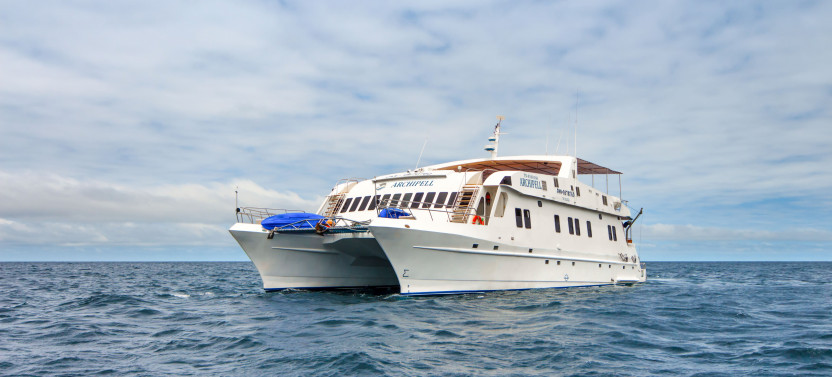
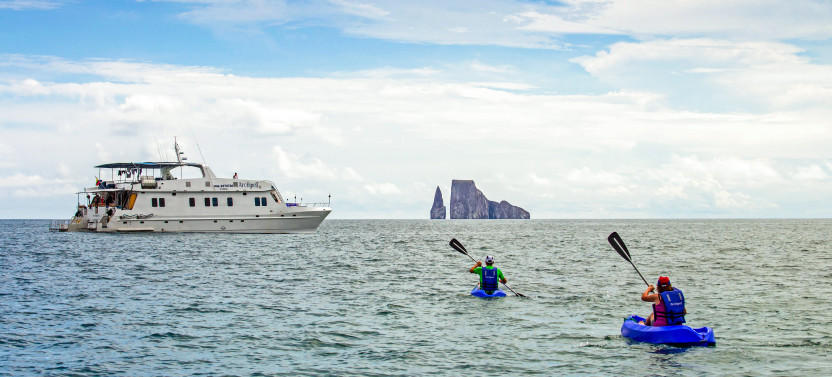
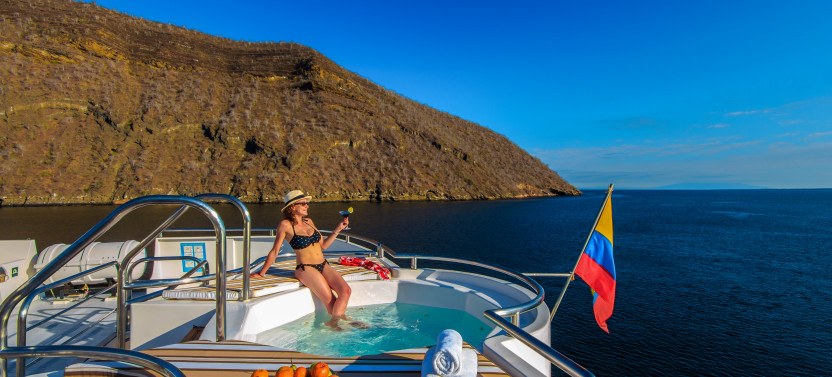
Motor Catamarans Archipel I cruise around the great outdoors of the breathtaking Galapagos Archipelago, where you will keep discovering one surprise after another! Every day we anchor at two selected visitor’s sites and organize at least two excursions. You will observe nature from different perspectives with our balanced excursion program, or even during your spare time. Type, Class & Capacity Category: Tourist Superior Type: Motor catamaran Length: 27m / 88ft Beam: 11m / 36ft Capacity: 16 passengers Main Deck: 2 cabins with double beds, 6 cabins with twin beds Social areas & Amenities: Dining room, bar, and conference area with television, DVD player, chart games, a library of books and DVDs
At a Glance
The experience, in brief
- Stay fit & refreshed and fully enjoy all activities (included in cruise price!)
- Have a more intimate nature experience
- An expert naturalist guide who brings nature even more to life
- Personal attention from our welcoming staff
Your Itinerary
Your day, step by step
Day 1
Baltra
Transportation at Santa Cruz Island (Galapagos). DAY 1 - MONDAY: AM - Arrival at Baltra airport Upon arrival at Baltra airport, you will pass through an airport inspection point to ensure that no foreign plants or animals are introduced to the islands, as well as to pay the park entrance fee (unless it has been prepaid). A guide will meet you, help you collect your luggage, and escort you on a short bus ride to the harbor.
Continued
Puerto Baquerizo Moreno
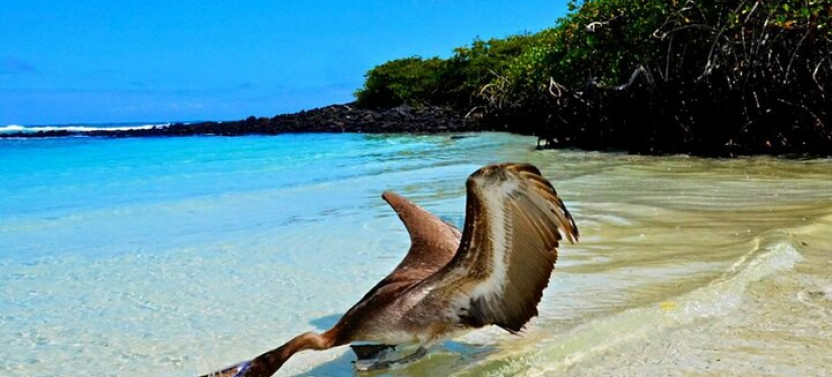
Eco Tour at Santa Cruz Island (Galapagos). PM – Bachas (Santa Cruz): These two small beaches are located in the west of Turtle Cove on Santa Cruz. Their sand consists of decomposed corals, which makes it white and soft. This makes it the favorite nesting site for sea turtles. Behind one of the beaches, there are small water lagoons, where flamingos and other coastal birds, such as black-necked stilt birds and rainbows, can occasionally be spotted. On the second beach, which is the wider one, you can explore the remains of two abandoned warships. In the Second World War, these were left by the US, as the island of Baltra was used as a strategic point for the protection of the Panama Canal.
Continued
Puerto Baquerizo Moreno
Accommodation.
Day 2
Puerto Baquerizo Moreno
Hiking at Genovesa Island. DAY 2 - TUESDAY: AM - Prince Philip’s Steps (Genovesa) Before landing, you will take a dinghy ride along the eastern arm of the caldera. As you approach, the soaring 25 m/80 ft high walls become overwhelming. Sometimes, a Galapagos fur seal is resting, or a seabird is nesting on one of the ledges at the base. You will then have to hike and overcome the steep stairs from the landing dock to a bush of palo santo shrubs on top. Red-footed boobies gratefully use these scarce nesting places; so that they don’t have to nest on the rocky ground. Upon arriving at the edge of the rim, the bushes open up and you can enjoy panoramic views, a strong sea breeze, and the amazing flying skills of countless seabirds. Following the exposed rim, you will first pass the Nazca boobies and finally reach the extensive storm petrel nesting places, where, if you’re lucky, you can spot the well-camouflaged short-eared owl hunting for food!
Continued
Puerto Baquerizo Moreno
Eco Tour at Genovesa Island. PM - Darwin Bay (Genovesa): Inside the submerged caldera of Genovesa lies Darwin Bay, with a diameter of more than 1.5 km/1 mi and it is almost 200 m/650 ft deep. The small area will surprise you repeatedly, walking along a coral sand beach, crossing barren lava formations and creeks, passing tidal pools, shrubs and further ahead following the top of some cliffs. With these peaceful surroundings, every single species has occupied its ecological niche (or habitat) without disturbing others.
Continued
Puerto Baquerizo Moreno
Accommodation.
Day 3
Puerto Baquerizo Moreno
Hiking at Bartolomé Island. DAY 3 - WEDNESDAY: AM - Bartholomew The beautiful volcanic islet of Bartholomew is among the youngest of the islands and, on a geological scale, was just recently born out of the fire. Although it looks lifeless at first sight, Bartholomew offers some of the wildest landscapes and best panoramas of the entire archipelago. To enjoy the postcard view of the idyllic “Pinnacle Bay” you will have to climb the stairs to the viewpoint on top of the island (114 m/375 ft). Enter a dramatic world of threatening (though extinguished) nearby spatter cones, craters, and lightweight lava droplets that have been spewed out by fiery fountains. The summit trail is also ideal for witnessing how scanty pioneer vegetation, such as lava cactus, struggles to take root in the bare virgin lava fields.
Continued
Puerto Baquerizo Moreno
Sightseeing at Sullivan Bay. PM - Sullivan Bay (Santiago): The arrival in Sullivan Bay is like a moon landing. The desolate, sprawling fields seem to be mostly lifeless, but this island, which is particularly popular among photographers, still offers a lot to see. There is even some life! Green sea turtles burrow in the small white sand beach, where you can also find crabs, blue herons, and oystercatchers.
Continued
Puerto Baquerizo Moreno
Accommodation.
Day 4
Puerto Baquerizo Moreno
Eco Tour at Santa Cruz Island (Galapagos). DAY 4 - THURSDAY: AM - Twin Craters and El Chato Reserve (Santa Cruz) The native scalesia forest of El Chato Tortoise Reserve is the best place to search for Galapagos giant tortoises in their most authentic setting! Despite the interesting breeding centers – where you are guaranteed to find tortoises in their corrals – there is nothing better than to observe them in their wild environment. Though it can be quite moist and muddy, your visit may turn into an adventurous quest when they have left their favorite pond silently. The Twin Craters are found on either side of the road leading to Puerto Ayora. These impressive formations are not volcanic craters and were formed by magma domes, which hardened on the outside while the lava continued flowing inside, leaving huge and empty magma chambers that eventually collapsed, leaving two large holes. The craters lie within a lush scalesia cloud forest, a high-altitude plant species that is endemic to the Galapagos. This area is also home to the carpenter finch, which uses tools to search for food. There may also be opportunities to see the vermillion flycatcher, a small, red-breasted bird . PM - Fausto Llerena Breeding Centre (Santa Cruz): At this site, you can observe tortoises that come from various islands of the archipelago. They comply with the captive breeding program and then return to repopulate the areas where their population has been affected. The land iguanas of Santa Cruz, Isabela, and North Seymour are also in a captive breedingprogramd, as the populations in these areas suffered from feral dogs. One of the main attractions is the famous embalmed Lonesome George. Estimated to have died between 93 and 109 years of age, it is recognized as the last of its kind and a symbol of the efforts invested to conserve endangered species. The captive tortoises are used to the presence of visitors, so it's a great place to take photos with them.
Continued
Puerto Baquerizo Moreno
Accommodation.
Day 5
Floreana Island
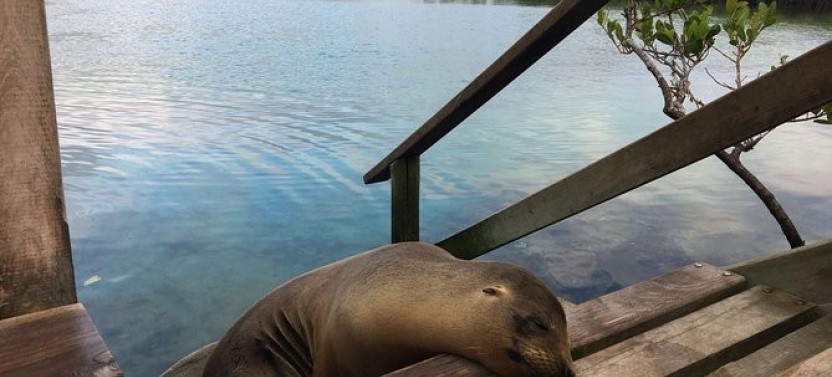
Eco Tour at Galapagos Islands. DAY 5 - FRIDAY: AM - Cormorant Point and Devil’s Crown (Floreana) The peninsula of Cormorant Point forms the extreme north cape of Floreana, which exists out of smaller volcanic cones, covered by a tropical dry forest of palo santo. At the landing beach, you will be welcomed by a small Galapagos sea lion colony. The green sand on this beach contains a high percentage of glassy olivine crystals which have been blown out by the surrounding tuff cones. The “flour sand” beach on the southern side of the peninsula is made up of even finer white coral sand which feels very smooth on the feet. Parrotfish have pulverized it, grinding the calcareous skeletons of living coral. You can spot schools of stingrays who love the sandy bottom to hide. During the first months of the year, Pacific green turtles come ashore to bury their eggs. Devil’s Crown offers one of the best snorkeling spots in the Galapagos due to the coral reef in its center, which attracts a lot of marine life. Here you can spot Galapagos penguins, sea lions, sea turtles, many different colorful fish, and even some dolphins. The current can be a bit strong sometimes, so it should not be attempted by novice swimmers.
Continued
Floreana Island
Leisure at Galapagos Islands. PM - Post Office Bay and Baroness Lookout (Floreana): Historically, this site is the location of a wooden barrel that was placed there in the 18th century by the crew of a whaling ship. Letters found inside the barrel were collected and delivered by sailors returning home. There was no postage fee and, surprisingly, this mailbox and its honor systems are still in use today. Although letters are no longer important messages from sailors to their loved ones, tourists leave thousands of them today and many still reach their destination. You can also relax on the beach, where in addition to Galapagos sea lions, Pacific green turtles, and golden rays, you may see Galapagos penguins. This is the only place in the southeastern archipelago where penguins reside. You can also climb the small basaltic cone of the Baroness Lookout and enjoy the paradisiacal views of the coastline. This viewpoint was the favorite spot of one of Floreani's first settlers, the eccentric baroness and self-proclaimed "Empress of Galapagos" Eloisa von Wagner, who even built her house a few meters further back.
Continued
Puerto Baquerizo Moreno
Accommodation.
Day 6
Puerto Baquerizo Moreno
Eco Tour at Espanola Island. DAY 6 - SATURDAY: AM - Osborn Islet and Gardner Bay (Española) The striking white beach at Gardner Bay is an important breeding site for Pacific green turtles. However, without a doubt, its main attraction is the Galapagos sea lion colony. Females stay year-round in this nursery, suckling their pups until they are three years old, although they start to fish at five months. During the breeding and mating season, the colony becomes even bigger.
Continued
Puerto Baquerizo Moreno
Sightseeing at Espanola Island. PM - Suarez Point (Española): Huge ocean waves crash onto the southern basaltic cliffs of Suarez Point, forming a spectacular blowhole, where the water sprays meters high into the air (depending on the season, the tide, and how strongly the sea breeze pushes the waves). Take your time for a meditative break in silence on this emblematic viewpoint and convert this unforgettable moment into a lifetime experience.
Continued
Puerto Baquerizo Moreno
Accommodation.
Day 7
Puerto Baquerizo Moreno
Eco Tour at San Cristobal Island (Galapagos). DAY 7 - SUNDAY: AM - Pitt Point (San Cristobal) Two wind-sculptured tuff cones at Pitt Point make up the extreme eastern end of San Cristobal, and thus, the archipelago as well. These cliffs were the first sight of land when HMS Beagle and Charles Darwin arrived on the 15th of September 1835. On the small green sand beach, you will be welcomed by a group of barking Galapagos sea lions. This is a bachelor colony, where males usually relax and prepare themselves for fighting and mating.
Continued
Puerto Baquerizo Moreno
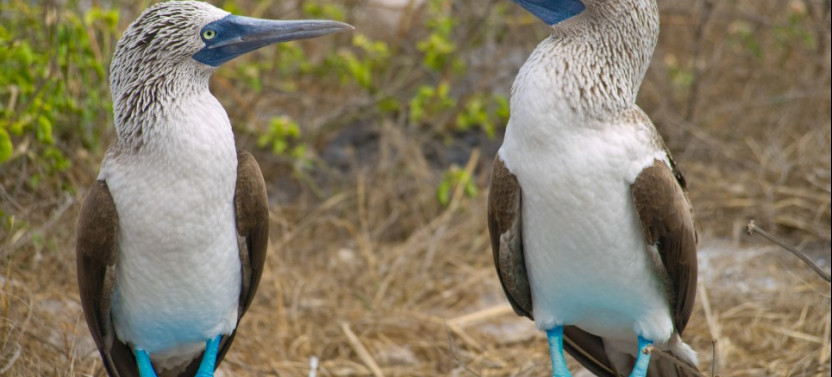
Leisure at San Cristobal Island (Galapagos). PM - Witch Hill (San Cristobal): The primary attraction of this site is the coral sand beach, an excellent place to swim and snorkel. Witch Hill is the remains of a tuff cone and one of the first sites visited by Charles Darwin. It has an impressive landscape, where it is often possible to see coastal and migratory birds, including pelicans, blue-footed boobies and swallow-tailed gulls, as well as sea lions and marine iguanas. At times, the lagoon is completely dry, and deposits of salt can be found at the bottom. The people of Puerto Baquerizo Moreno used to use the lagoon as a salt mine.
Continued
Puerto Baquerizo Moreno
Accommodation.
Day 8
Puerto Baquerizo Moreno
Eco Tour at San Cristobal Island (Galapagos). AM - Lobos Islet (San Cristobal): The Lobos Islet’s beach harbors a colony of Galapagos sea lions. As in other colonies in the archipelago, you can approach nurturing females within a few meters. In the breeding season, this colony is also visited by territorial males, defending and mating the harem on their part of the beach. This low islet is home to more than just Galapagos sea lions. Two other emblematic species breed here: male blue-footed boobies and great frigate birds who try to impress the females (and tourists) with clumsy dances, heaving their striking blue feet or blowing up their balloon-sized scarlet pouches. During the breeding season, the fluffy and hungry chicks cry for food, and when their wings get strong enough, they will learn to fly.
Continued
Puerto Baquerizo Moreno
Transportation. After this, assisted by the naturalist guide and some crew members, you will be taken to San Cristobal airport. It has been a pleasure accompanying you on this unique trip and we hope to see you again very soon! Thanks for traveling with us!
Before You Go
What to know before booking
Included
Lodging on board in a cabin with private facilities All excursions as mentioned in the itinerary (itinerary subject to change) with English speaking naturalist guide Shared shuttle transfer to Quito or Guayaquil airport *only departure transfer (included only if the Galapagos flight has been booked through us on our scheduled departure cruise dates) All transfers in the Galapagos (airport-yacht-airport transfers are only guaranteed if the flight has been booked through us) Snorkeling gear (masks, flippers, and snorkel) and use of kayaks at designated sites
Not Included
Roundtrip flight to the Galapagos Islands Galapagos National Park entrance fee (an extra cost pp, subject to change) Transit Control Card (an extra cost pp, subject to change) Airport transfers in the Galapagos (only included if the Galapagos flight has been booked through us on the scheduled cruise dates. * If your arrival/departure is different than our scheduled cruise flights, the shuttle service is not included) Wetsuit rental Soft and alcoholic drinks Tips Travel Insurance
What to Bring
Comfortable shoes Comfortable clothes Biodegradable sunscreen
Meeting & Pickup
Pickup from Baltra airport
Planning Notes
Hotel pickup offered: Yes Confirmation: Manual By Business
 Featured Travel